Table of Contents
- 1 Egg White or Egg Yolk — Which One Is Actually Right for Your Skin?
- 2 How a Refrigerator Egg Became My Skincare Routine
- 3 Egg White vs Egg Yolk — They Do Completely Different Things
- 4 3 Korean Egg Face Mask Recipes — Find the One That Fits Your Skin
- 5 Common Egg Face Mask Mistakes — And How to Avoid Them
- 6 F A Q
- 7 Open Your Fridge Tonight
Egg White or Egg Yolk — Which One Is Actually Right for Your Skin?
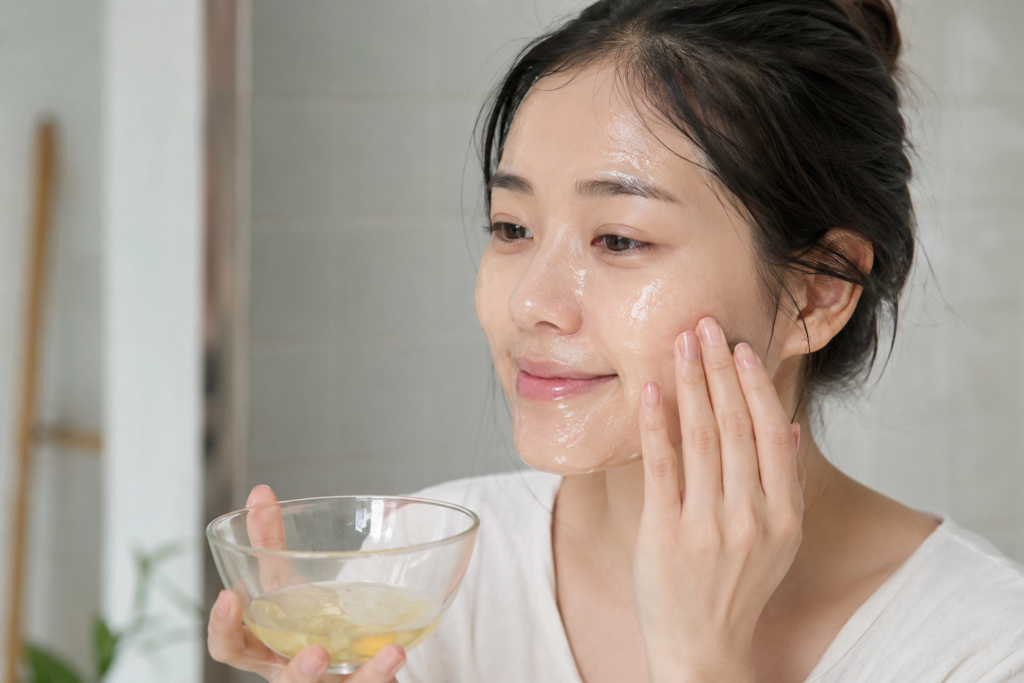
Most people know that egg face masks
are good for the skin.
But not everyone knows that egg white
and egg yolk do completely different
things — and using the wrong one
for your skin type can actually
work against you.
Today I want to explain the real
difference between egg white and
egg yolk face masks, and help you
find the right Korean egg face mask
recipe for your skin. 🥚
This is part of my Korean home care series. Start from the beginning
→ Korean Cucumber Face Mask: 4 DIY Recipes for Glowing Skin
How a Refrigerator Egg Became My Skincare Routine
In Korea, egg face masks were a
well-known home beauty remedy long
before sheet masks became popular.
It was the kind of thing mothers
passed down to their daughters
without much explanation — because
the ingredients were always already
in the fridge.
Even today, Korean drugstores like
Olive Young carry entire product
lines built around egg-derived
ingredients. That’s how naturally
eggs fit into Korean skincare culture.
I started the same way.
In my early twenties, I was a student
with almost no budget for skincare.
During exam periods, my skin would
look dull and tired. Before important
presentations, I’d find myself
stressing about my skin more
than the presentation itself.
So I opened the fridge.
There was always an egg.
The night before a big presentation,
I’d do an egg white mask and wait
for it to dry completely. Something
about the way my skin felt afterward —
tighter, smoother, more put-together —
gave me a strange kind of confidence.
It cost nothing. And it worked.
Looking back, it was actually
a pretty smart choice.
Egg White vs Egg Yolk — They Do Completely Different Things
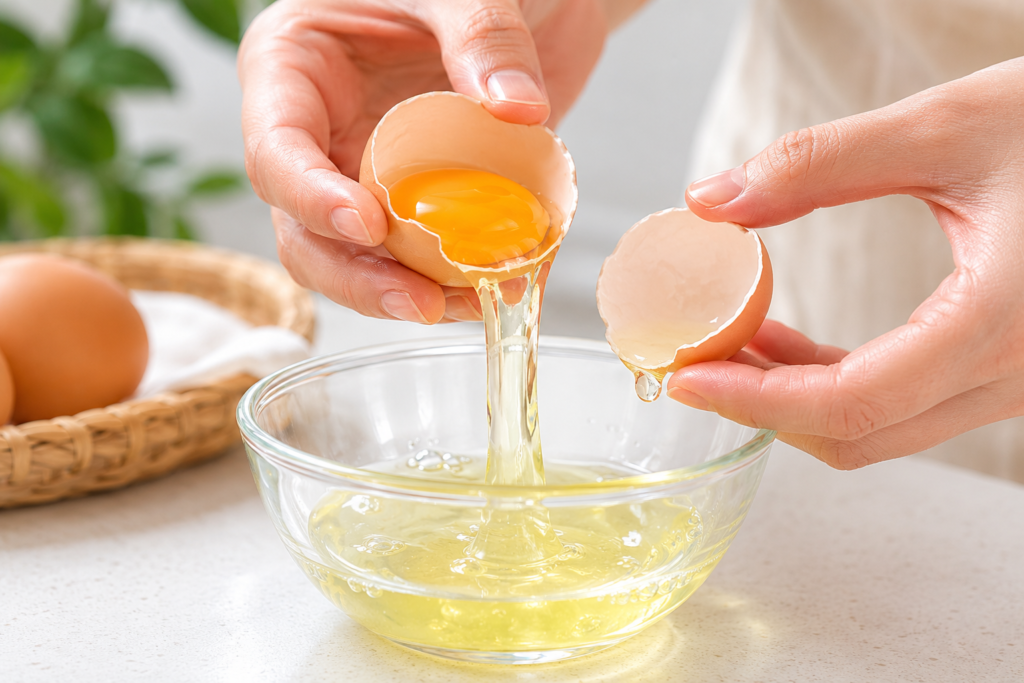
One egg contains far more
skin-beneficial compounds than
most people realize.
But the white and the yolk
work in entirely different ways.
What’s Inside Egg White
Protein may help the skin feel
temporarily firmer and make pores
appear less prominent on the surface.
Lysozyme has antimicrobial properties
that may help support skin prone
to breakouts.
Biotin is associated with supporting
overall skin health and resilience.
What’s Inside Egg Yolk
Vitamin A may help support skin
cell renewal and a smoother-feeling
skin texture over time.
Vitamin E may provide antioxidant
support, helping protect the skin
from everyday environmental stressors.
Lecithin may help support skin
moisture and suppleness.
Fatty acids may help nourish
dry or dehydrated skin with
sustained moisture.
At a Glance
| Egg White | Egg Yolk | |
|---|---|---|
| Main benefit | Firming feel, skin-tightening | Hydration, nourishment |
| Best for | Oily, acne-prone skin | Dry, sensitive skin |
| Texture | Light, clear | Rich, yellow |
| After feeling | Fresh, clean | Soft, moisturized |
| Best season | Spring, summer | Autumn, winter |
3 Korean Egg Face Mask Recipes — Find the One That Fits Your Skin
Recipe 1. Egg White Face Mask — For Oily and Combination Skin
This was the one I reached for
most often as a student.
The way it left my skin feeling
clean and refreshed without any
heaviness was something I kept
coming back to.
What you need:
One egg, white only.
How to do it:
Separate the egg white into
a clean bowl. Whisk lightly
until it becomes slightly foamy.
After cleansing, apply evenly
to your face. Wait until it dries
completely — about 15 to 20 minutes.
Rinse off with lukewarm water.
As the mask dries, you’ll feel
your skin tightening. That’s normal.
Afterward, the skin may feel
temporarily firmer and pores
may appear less noticeable
on the surface.
Best for:
Oily skin, visibly enlarged pores,
skin prone to breakouts.
Recipe 2. Egg Yolk Face Mask — For Dry and Sensitive Skin
On days when the tightening sensation
of egg white felt like too much,
I switched to egg yolk.
The difference is immediately noticeable.
In Korea, egg yolk masks are especially
popular in winter or whenever the
skin feels particularly dry and stripped.
What you need:
One egg, yolk only.
How to do it:
Separate the egg yolk into
a clean bowl. Whisk until smooth.
After cleansing, apply evenly
to your face. Leave on for
15 to 20 minutes. Rinse off
with lukewarm water.
After rinsing, the skin feels
noticeably soft and nourished —
the opposite sensation from
the egg white mask.
Best for:
Dry skin, skin that feels tight
and dehydrated, skin that needs
extra nourishment.
Recipe 3. Egg White and Honey Mask — For All Skin Types, Especially Beginners
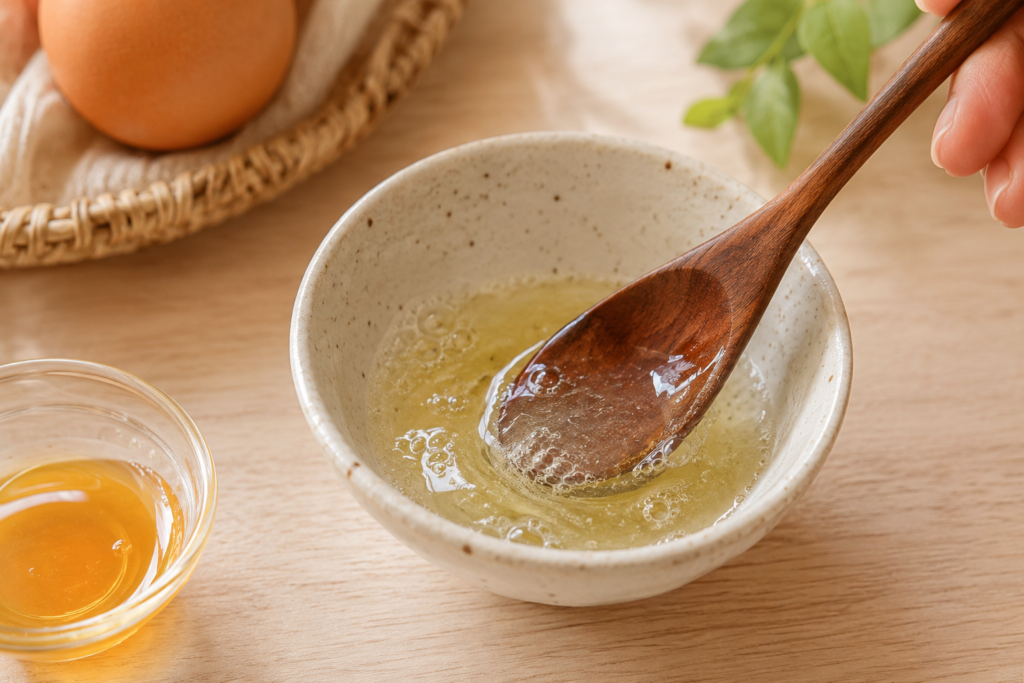
This was my favorite combination
as a student.
The honey softens the tightening
effect of the egg white while
adding a layer of hydration —
so you get the firming benefits
without the dry, pulled feeling
some people find uncomfortable.
If you’ve never tried an egg face
mask before, start here.
What you need:
One egg white and one teaspoon
of honey.
How to do it:
Separate the egg white. Mix in
the honey until evenly combined.
After cleansing, apply to your face.
Leave on for 15 to 20 minutes.
Rinse with lukewarm water.
Best for:
Combination skin, anyone who wants
both firming and hydrating benefits,
first-time egg mask users.
Want to know more ways Koreans
use honey for skin? →
Korean Honey Face Mask
Common Egg Face Mask Mistakes — And How to Avoid Them
Most people who don’t feel results
from egg masks are making one
of these mistakes.
Mistake 1. Using Egg White Too Often
Egg white masks are effective
precisely because they have
a strong tightening effect.
But used too frequently, they can
leave the skin feeling dry and
stripped. Once or twice a week
is enough.
Mistake 2. Rinsing Too Early
With egg white masks especially,
the mask needs to dry completely
before you rinse it off.
Washing it away after 10 minutes
because it feels uncomfortable
significantly reduces the effect.
Give it the full 15 to 20 minutes.
Mistake 3. Using Hot Water
Hot water can irritate the skin
and may cause egg protein to
bond to the skin surface in
an unpleasant way.
Always use lukewarm water to rinse.
Mistake 4. Skipping Moisturizer Afterward
After an egg white mask,
the skin can feel quite tight.
Skipping your toner and moisturizer
after the mask can leave the skin
more dehydrated than before.
Moisturizing after is not optional.
Mistake 5. Using Old Eggs
Eggs past their best will smell
stronger and may irritate the skin.
Always check the expiration date
before using eggs on your face.
──────
F A Q
Q1. How often should I do an egg face mask?
For egg white masks, once or twice
a week is the right frequency.
For egg yolk masks, two to three
times a week is generally fine.
Always pay attention to how
your skin responds.
Q2. What about the egg smell?
The smell during the mask is normal.
It doesn’t linger after you rinse.
Adding a few drops of lemon juice
to the mixture can help reduce
the scent while you wear it.
Q3. What if I’m sensitive to eggs?
Do a patch test on your inner arm
first and wait 24 hours. If you
have a confirmed egg allergy,
skip this one entirely.
Q4. Can I use the whole egg at once?
Yes. Whisking the whole egg together
and applying it to your face is
a valid option if you want the
combined benefits of both white
and yolk in one step.
Q5. Do I need to wash my face after the mask?
Yes. Rinse thoroughly with lukewarm
water. Leaving egg residue on
the skin can clog pores and
cause irritation.
──────────────────────────────────
Open Your Fridge Tonight
Now you know the difference
between egg white and egg yolk —
and which one is actually right
for your skin.
Pick the recipe that fits what
your skin needs tonight and
give it 15 minutes.
You don’t need expensive products.
You don’t need a complicated routine.
Just one egg from the fridge.
Good skin doesn’t require a big budget.
It requires consistency — and
sometimes, the right ingredients
have been sitting in your kitchen
the whole time. 🥚
Egg white, egg yolk, or honey mix —
which one are you going to
try first?
Let me know in the comments —
I’d love to hear how it goes!
Next in this series →
Korean Milk Face Mask —
The Bathhouse Beauty Secret