Table of Contents
- 1 Why My Skin Looks Better at 40 Than It Did at 30
- 1.1 What Turning 40 Actually Felt Like for My Skin
- 1.2 Foods I Actually Eat for My Skin
- 1.3 The Daily Habits That Made More Difference Than Any Product
- 1.4 Why Koreans Tend to Look Younger: The Part That Makes Sense to Me Now
- 1.5 What I Actually Do
- 1.6 Frequently Asked Questions
- 1.6.1 What foods are best for skin in your 40s?
- 1.6.2 What is the most important daily habit for skin in your 40s?
- 1.6.3 Do foods really affect skin condition?
- 1.6.4 Why is green tea good for skin?
- 1.6.5 Is it too late to start these habits in your 40s?
- 1.6.6 What foods do Korean women eat for healthy skin?
- 1.6.7 Why do Korean women tend to look younger than their age?
- 1.7 Final Thoughts
- 1.8 Related Articles
Why My Skin Looks Better at 40 Than It Did at 30
I turned 40 this year.
I spent my mid-twenties in Korea, then lived across six countries in Europe — Italy, Germany, Slovakia, Switzerland, the UK, and the Netherlands — before coming back. Ten years in total, six countries, and more climate changes than I can count.
People tell me my skin looks good. It always feels like a strange compliment to receive, because I was not someone who took care of her skin particularly well when she was younger. I went to bed without washing my face more than once in my twenties. I wore sunscreen in summer and barely thought about it the rest of the year.
Looking back from forty, what changed my skin was not an expensive serum or a new product. It was the food habits and daily routines I picked up — sometimes intentionally, sometimes without even realising — while living in Europe.
This post is not about skincare products. It is about what I eat and what I do every day.
What Turning 40 Actually Felt Like for My Skin
It was not about wrinkles
Most people expect the first sign of skin aging to be wrinkles. I did too.
What I noticed first was something different: recovery. In my twenties, a late night left no trace by the next morning. In my forties, one bad night’s sleep shows up on my face immediately. A stressful week, and the firmness visibly drops. What used to bounce back in a day now takes several.
Forty did not make my skin old. It made it slower to recover. That distinction matters, because it completely changed how I thought about what my skin actually needs.
What Europe taught me about food and skin
While living in Europe, I heard far more about food and skin than I ever had in Korea. Friends in Germany and the Netherlands had a saying I kept hearing: good skin starts in the kitchen.
I was skeptical at first. Now I think they were right.

Foods I Actually Eat for My Skin
Blueberries and berries
I started eating berries regularly when I was living in Germany and the Netherlands. They were cheap, easy to find, and I got into the habit of adding them to yoghurt in the mornings or eating them as a snack.
Berries are rich in anthocyanins, which are associated with antioxidant effects that may help protect skin cells from oxidative stress. When I came back to Korea, the habit came with me.
Tomatoes
In summer I eat tomatoes almost every day — in salads, or just on their own as a snack. Living in Italy made tomatoes a daily staple, and that never really went away.
Tomatoes contain lycopene, which is thought to offer some protective effect against UV-related skin damage. I think of it as a second line of defence alongside sunscreen, though not a replacement for it.
Salmon and oily fish
I try to eat salmon or another oily fish once or twice a week. On the days after I do, my skin tends to feel less dull and dry.
Omega-3 fatty acids found in oily fish are associated with skin hydration and reducing inflammation. I started eating salmon more regularly in Switzerland, partly because it was everywhere, and I noticed my skin felt less tight that winter than in previous years.
Nuts
Almonds and walnuts are a daily habit now. It started as a way to replace snacking on processed food and became something I just do automatically.
Almonds are a good source of vitamin E, which is associated with skin moisture, and walnuts contain omega-3s. Swapping an afternoon snack for a small handful of nuts is one of the smallest changes I made that I think had a noticeable effect.
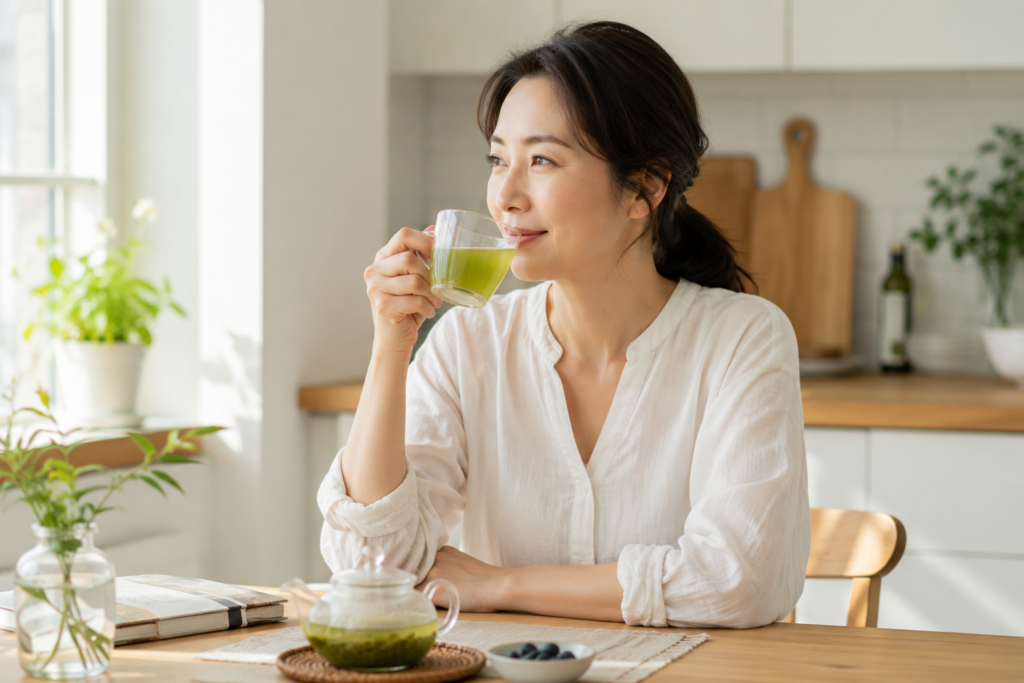
Green tea
In the afternoons I often drink green tea instead of a second coffee. It started for health reasons and became a routine.
Green tea contains catechins, which have antioxidant properties and are associated with supporting skin condition over time. I have not given up coffee entirely — I drink it in the morning — but replacing the afternoon cup with green tea is something I have kept up for years.
The Daily Habits That Made More Difference Than Any Product
Food is half of it. The other half is what I do every day — habits I formed mostly in Europe that I have kept ever since.
1. Sunscreen every day, regardless of weather
In my twenties, sunscreen was something I associated with summer. Living in the UK changed that. Even on overcast days, UV exposure continues, and I started wearing sunscreen daily without exception from my mid-thirties onward.
If I had to choose one single habit from everything in this post, it would be this one. Daily sunscreen use has a compounding effect over years and decades that no serum or cream can replicate. It is the habit I wish I had started earlier.
2. Protecting sleep
Skin in your forties cannot be fooled by a good serum after a bad night. Sleep is when skin repairs itself, and the difference between six hours and eight hours shows on my face the following morning in a way it never did before.
In the early years of living in Europe, time zone adjustments and irregular schedules disrupted my sleep often. My skin was the first thing to show it.
3. Drinking water consistently through the day
This sounds too simple to matter. It does matter. In dry seasons — or in the heating-heavy winters I experienced in Germany and Slovakia — keeping up with water intake made a visible difference in how tight and dull my skin felt by the end of the day.
Topical moisturiser helps, but hydrating from inside tends to address dryness in a way that applying more cream does not always fix.
4. Moisturising before the skin feels dry
The timing of moisturiser matters more than most people realise. Applying it before the skin fully dries — within about thirty seconds of cleansing — locks in moisture more effectively than waiting until the skin already feels tight.
I learned this the hard way in the Netherlands, where cold wind damaged my skin barrier repeatedly until I figured out that reacting to dryness was less effective than staying ahead of it.
Why Koreans Tend to Look Younger: The Part That Makes Sense to Me Now

European friends asked me this regularly: why do Korean people tend to look younger than their age?
There are genetic factors involved, and I would not dismiss those. But the more I think about it, the more I believe the biggest reason is a prevention-first mindset. In Korea, skincare — and to some extent, the broader lifestyle around it — tends to start early. Sunscreen from your twenties. Attention to diet. Consistency as a default rather than an exception.
Ten years outside Korea gave me the perspective to see this more clearly. It is not a single product or a single habit. It is the accumulation of small, consistent things done over a long time.
Many foreign friends have asked me why Korean women often look younger than their age. After living both inside and outside Korea for many years, I realised it has less to do with one miracle product and more to do with small habits practiced consistently over time. If you’re interested, I wrote a detailed guide about why Koreans tend to look younger and the habits that contribute to it.
What I Actually Do
| Category | What I Do | Why It Helps |
|---|---|---|
| Food | Blueberries and berries daily | Antioxidant support for skin cells |
| Food | Tomatoes regularly | Lycopene, UV protection support |
| Food | Salmon or oily fish 1–2x per week | Omega-3s for skin hydration |
| Food | Almonds and walnuts daily | Vitamin E and omega-3 for skin condition |
| Food | Green tea in the afternoon | Catechins, antioxidant support |
| Habit | Sunscreen every day | UV protection, the strongest anti-aging habit |
| Habit | 7–8 hours sleep | Skin repair and recovery overnight |
| Habit | Drinking water consistently | Reduces tightness and dullness |
| Habit | Moisturising before skin feels dry | Locks in moisture more effectively |
Frequently Asked Questions
What foods are best for skin in your 40s?
No single food transforms skin on its own. The pattern that seems to make a difference is eating antioxidant-rich foods — berries, tomatoes, green tea — alongside foods with omega-3s like salmon and walnuts, consistently over time rather than occasionally.
What is the most important daily habit for skin in your 40s?
Daily sunscreen, without exception. More than any serum, cream, or dietary change, consistent UV protection has the most significant long-term impact on how skin ages.
Do foods really affect skin condition?
They do, though not in ways that show up overnight. The effects are cumulative. I noticed the difference most with oily fish and nuts — my skin felt less dry and dull when I was eating them regularly compared to when I was not.
Why is green tea good for skin?
Green tea contains catechins, which are antioxidants associated with reducing oxidative stress in the body. Replacing one coffee a day with green tea is a small change that is worth trying before committing to a more significant routine overhaul.
Is it too late to start these habits in your 40s?
Not at all. Earlier is easier, but starting in your forties still produces results. The habits I built during my thirties in Europe are the ones shaping my skin now. It is never the wrong time to start something that compounds over time.
What foods do Korean women eat for healthy skin?
There is no single food responsible for healthy skin, but many Koreans regularly eat foods such as tomatoes, seaweed, fish, fermented foods, green tea, and seasonal fruits. Combined with consistent sun protection and hydration, these habits may contribute to healthier-looking skin over time.
Why do Korean women tend to look younger than their age?
From what I have seen — both living in Korea and spending a decade outside it — it comes down more to habit than genetics. Daily sun protection from a young age, consistent hydration, and a general approach to prevention rather than correction all add up. If you want to read more about this, I have a full post on why Koreans look younger that goes into the details.
Final Thoughts
Ten years in Europe taught me that skin is shaped as much by what you eat and how you live as by what you put on your face.
The anti-aging foods and daily habits that matter most do not have to be complicated or expensive. A handful of blueberries, a cup of green tea in the afternoon, sunscreen every morning, enough sleep. These are not dramatic interventions. They are small things, done consistently, that accumulate into something visible over time.
Before reaching for a new product, it is worth asking what you ate today, how much water you drank, and how long you slept last night. That is usually where the answer is.