Table of Contents
- 1 Chimaek — Korean Chicken and Beer: The Culture Even Jensen Huang Can’t Resist
- 1.1 What Is Chimaek? Korea’s Most Beloved Food Culture Explained
- 1.2 Why Is Chimaek So Ridiculously Popular?
- 1.3 My Chimaek Memories — Because Everyone in Korea Has Them
- 1.4 Korean Fried Chicken Types — What to Order at Your First Chimaek
- 1.5 Where to Enjoy Chimaek in Seoul
- 1.6 Chimaek Tips for Tourists — Read Before You Order
- 1.7 FAQ About Chimaek — Korean Chicken and Beer
- 1.7.1 What does chimaek mean?
- 1.7.2 How is Korean fried chicken different from Western fried chicken?
- 1.7.3 Where can I eat chimaek in Seoul?
- 1.7.4 Where did Jensen Huang eat chimaek in Seoul?
- 1.7.5 Can I order chimaek delivery at Han River?
- 1.7.6 How much does chimaek cost in Korea?
- 1.7.7 What is hon-chimaek?
- 1.7.8 What should I order at my first chimaek?
- 1.8 🔗 Internal Links
- 1.9 🌐 External Linksenglish.visitseoul.net
Chimaek — Korean Chicken and Beer: The Culture Even Jensen Huang Can’t Resist
In October 2025, Jensen Huang — CEO of Nvidia and arguably the most talked-about person in the tech world — flew into Seoul. You might expect someone of his stature to head straight for a Michelin-starred tasting menu, maybe a private dining room with a dress code and a wine list nobody actually understands. Instead, he pulled up a chair at Kkanbu Chicken in Gangnam, cracked open a cold beer with Samsung’s Jay Y. Lee and Hyundai’s Euisun Chung, and got to work on a plate of fried chicken. Cameras crowded outside. Journalists jostled for a photo. And Huang, grinning, looked up and said — “I love fried chicken and beer with my friends. Kkanbu is a perfect place.” Korean fried chicken stocks surged the next morning. Because of course they did. But here’s the thing — for anyone who actually lives in Korea, none of this was surprising. Chimaek has always been this good. The rest of the world is just catching up.
What Is Chimaek? Korea’s Most Beloved Food Culture Explained
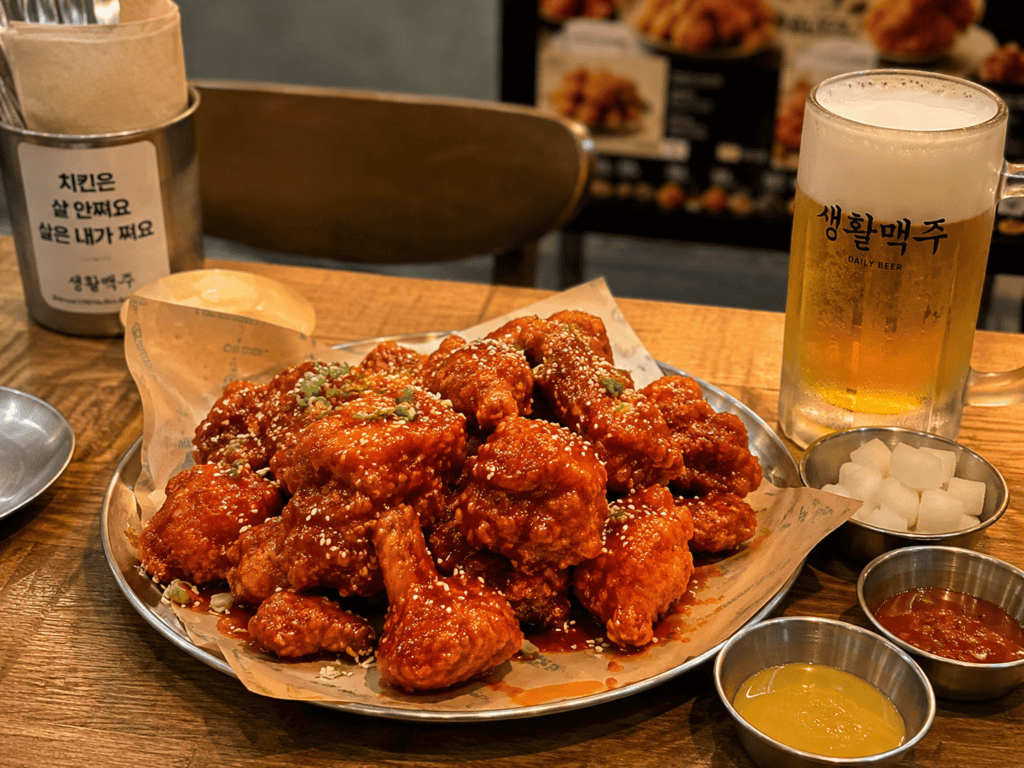
Chimaek (치맥) is a combination of the Korean words chikin (fried chicken) and maekju (beer), and it describes exactly what it sounds like — fried chicken and beer, enjoyed together, preferably with good company and zero formality. It’s not a dish. It’s not a meal. It’s an event. Chimaek first exploded into the national consciousness during the 2010 World Cup, when Koreans gathered in the streets to cheer, eat chicken, and drink cold beer all at once — and realized this was actually the perfect way to exist. Then in 2014, the Korean drama My Love from the Star featured a scene of actress Jun Ji-hyun eating chimaek on a snowy night, and the entire continent of Asia promptly lost its mind. Chinese tourists began flying to Seoul specifically to try chimaek. The rest, as they say, is delicious history.
Why Is Chimaek So Ridiculously Popular?
It’s Affordable — And That’s the Whole Point
One whole chicken, a few cans of cold beer, and you have a meal that feels like a celebration without actually costing like one. Chimaek isn’t trying to be fancy and that’s exactly why it works. There’s something deeply satisfying about food that doesn’t require a reservation.
You Can Eat It Absolutely Anywhere
At a chicken hof. On the grass at Han River. In a tent. At a folding table on your rooftop. On your sofa in pajamas at eleven o’clock on a Tuesday. Korea has more fried chicken restaurants than any other country in the world, and if the restaurant isn’t within walking distance, the delivery app will take care of it in thirty minutes.
It Turns Any Situation Into a Good One
“We should get chimaek” is the Korean equivalent of “let’s figure this out over food.” After a long week at work. After a difficult exam. After literally anything. Chimaek has this uncanny ability to make a table of strangers feel like old friends by the second beer — and Koreans have known this for decades.
Korea’s Delivery Culture Was Built for This
Korea’s delivery infrastructure is world-class, and chimaek is the reason. Order fried chicken on Coupang Eats, pick up beer from the convenience store downstairs, and thirty minutes later you have a full chimaek setup without putting on real shoes. It is, genuinely, one of the great achievements of modern civilization.
My Chimaek Memories — Because Everyone in Korea Has Them
Han River Chimaek — The One That Started Everything
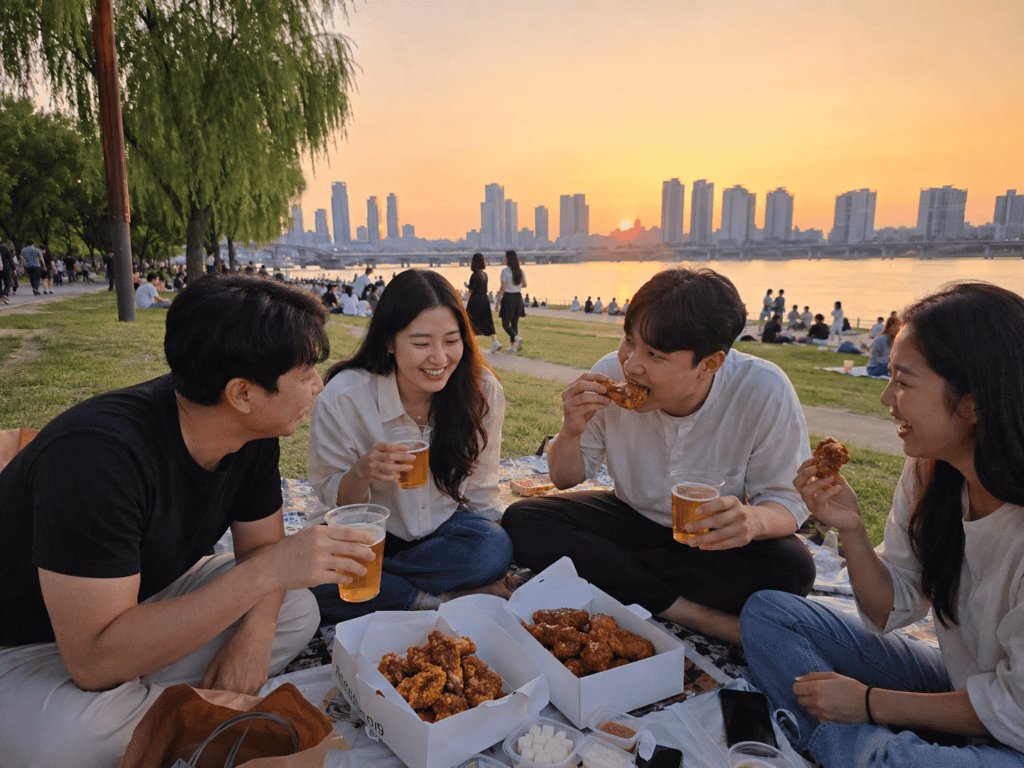
One summer evening, a group of us dragged a tent to Yeouido Han River Park, ordered two whole chickens, made someone run to the convenience store for beer, and sat there watching the city lights reflect off the water while the Han River breeze did exactly what it was supposed to do. I’ve eaten at nicer places. I’ve spent more money on food that took longer to arrive. But I genuinely cannot tell you a meal I’ve enjoyed more than that one. Sometimes the setting is the seasoning.
Valley Chimaek — Korea’s Most Underrated Summer Experience
Feet in a cold mountain stream, beer in one hand, a piece of yangnyeom chicken in the other, the sound of water running over rocks somewhere nearby. I lived in Europe for over ten years and this combination never once occurred to me. I came back to Korea, tried it once, and immediately understood why people plan entire summers around it. If you visit Korea in July or August and don’t find a valley to eat chicken in, I’m not sure what you’re doing.
University Chimaek — The Formative Years
End of exams. Everyone piling out of the lecture hall. Someone says “banban?” and before any real conversation happens, you’re already at the chicken place around the corner with a pitcher of beer on the table and absolutely nothing on the agenda. I don’t remember most of what we talked about on those nights. I remember that we laughed a lot, that the chicken was always a little too hot to eat immediately, and that nobody ever wanted to go home.
After-Work Chimaek — Korea’s Real Office Culture
Korean workplace culture can be intense — and chimaek is how the intensity gets processed. Not in a stuffy restaurant where you have to use the right fork. Just a chicken place, a table, some cold beer, and permission to be a normal human for two hours. I’ve had more honest conversations over chimaek with colleagues than I ever had in any meeting room.
Hon-Chimaek — Solo Chimaek and Proud of It
And then there’s hon-chimaek (혼치맥) — eating chimaek alone, and doing it on purpose. Sofa. Favourite drama. One whole chicken. A couple of cans of beer. No conversation required. My European friends always look slightly baffled when I describe this, but in Korea it’s not sad — it’s self-care. Hon-chimaek is a celebration of your own company, and frankly it deserves more international recognition than it gets.
💡 Planning chimaek at Han River? → Yeouido Seoul Travel Guide
Korean Fried Chicken Types — What to Order at Your First Chimaek
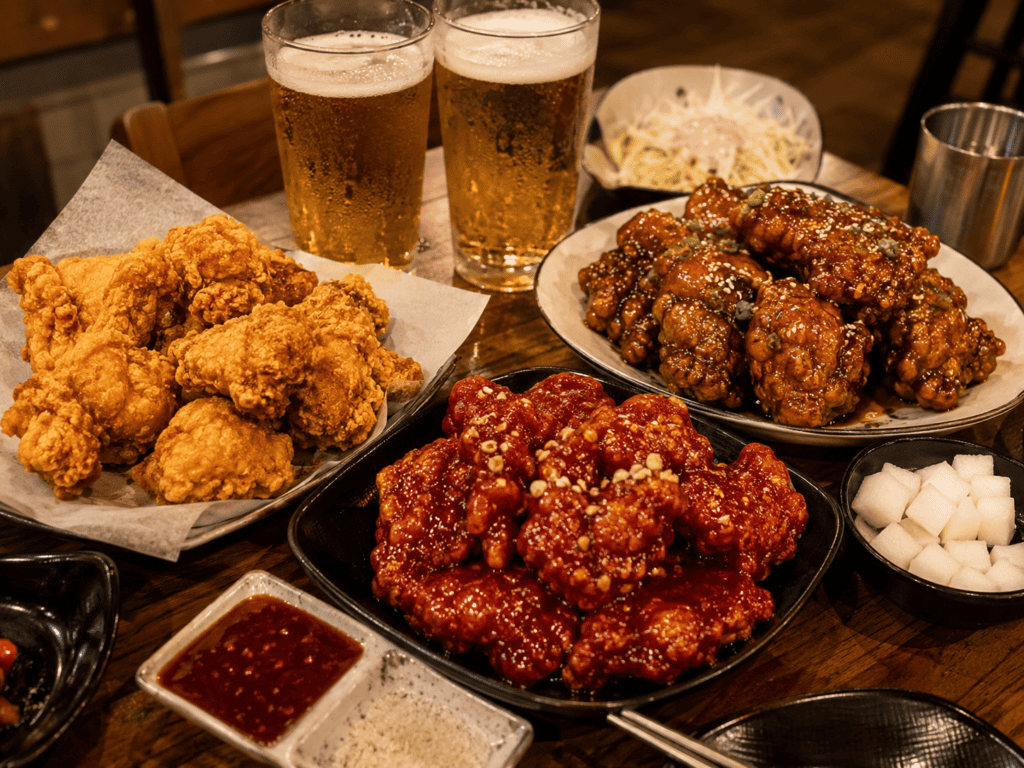
Huraideu (후라이드) — The Classic
Plain fried chicken, no sauce. If you think this sounds boring, you haven’t tried Korean double-fried chicken yet. The skin is so crispy it almost shatters, and the meat inside stays genuinely juicy. Start here if you want to understand what Korean fried chicken is actually about before the sauces get involved.
Yangnyeom (양념) — The One That Converts People
Sweet, spicy, sticky sauce coating every single piece. This is the one that makes foreign visitors go quiet for a moment, take another piece without saying anything, and then quietly revise their entire opinion of fried chicken. It’s that good.
Banban (반반) — Half and Half, the Genius Solution
Half huraideu, half yangnyeom. This is what you order when you can’t decide — which, for a first-timer, is always. It’s also the most frequently ordered combination in Korea, which tells you everything you need to know. When in doubt, go banban.
Ganjang (간장) — The Soy Garlic Option
Soy sauce and garlic glaze, sweet and savory without any heat. This is the one that tends to surprise people the most — it sounds mild, and then it’s somehow completely addictive. Kkanbu Chicken, the restaurant Jensen Huang visited, is particularly known for this style.
Cheese Chicken — Korea Being Korea
Cheese powder, cheese sauce, or melted cheese draped over fried chicken. Is it traditional? No. Is it something you’ll find yourself thinking about three days later? Also yes.
Where to Enjoy Chimaek in Seoul
Han River Parks — The Classic Chimaek Experience
Yeouido, Banpo, and Mangwon Han River Park are the most popular chimaek spots in Seoul. Order delivery to the park address through Coupang Eats, grab beer from the convenience store at the park entrance, find a patch of grass, and enjoy. Evening is best — the breeze comes off the water, the city lights come on, and the whole thing starts to feel slightly cinematic.
Kkanbu Chicken, Gangnam — Where Jensen Huang Ate
Located near Samseong Station in Gangnam, Kkanbu Chicken became internationally famous overnight after Jensen Huang, Jay Y. Lee, and Euisun Chung sat down for their now-legendary chimaek dinner. Kkanbu is also a Korean slang term for a very close friend — fitting, given that this is where three of the world’s most powerful businessmen apparently decided to just hang out and eat chicken together like normal people.
Chicken Hofs Everywhere — Don’t Overthink It
The best chimaek of your life will probably happen at a completely unremarkable chicken place near wherever you’re staying, with fluorescent lighting and plastic beer cups and a menu you had to point at because neither party spoke the other’s language. Don’t chase the fancy version of this. Just find a chicken hof, order banban, and let it happen.
Delivery at Home — The Full Korean Experience
Download Coupang Eats — it has an English interface and accepts international cards — search for chicken (치킨), and order. This is how most Koreans experience chimaek most of the time, and it’s a completely valid and deeply satisfying way to spend an evening in Korea.
💡 Curious about Korean food culture? → What Is Olive Young Korea?
Chimaek Tips for Tourists — Read Before You Order
Always Order Banban on Your First Visit
You cannot go wrong with half-and-half. It covers both Korean fried chicken styles in one order and gives you a proper introduction to what chimaek is actually about.
Buy Beer From the Convenience Store
Beer at a chicken restaurant is convenient but noticeably more expensive than the convenience store two doors down. If you’re eating at Han River, stock up before you get there.
Hon-Chimaek Is Completely Acceptable
Eating chimaek alone is a recognized and respected activity in Korea. Nobody will look at you strangely. Order one chicken, get comfortable, and enjoy your own company.
Use Coupang Eats for Delivery
English interface, international cards accepted, and it delivers to Han River park addresses. It’s genuinely the easiest way to order chimaek without speaking Korean.
Bring a Blanket for Han River Evenings
The breeze off the Han River is beautiful and also cold. Even in late summer, an evening by the water gets cooler than you expect. Bring something to wrap around yourself and you’ll stay much longer than planned.
Don’t Skip the Pickled Radish
Every chimaek order comes with cubes of sweet pickled radish (단무지). This is not a garnish. This is a palate cleanser between pieces of chicken, and it is essential. Eat it. Trust the system.
FAQ About Chimaek — Korean Chicken and Beer
What does chimaek mean?
Chimaek (치맥) is a Korean portmanteau of chikin (fried chicken) and maekju (beer). It refers to the combination of Korean fried chicken and beer as a cultural experience — not just a meal.
How is Korean fried chicken different from Western fried chicken?
Korean fried chicken is typically double-fried, giving it an exceptionally crispy exterior while keeping the inside juicy. It also comes in a much wider range of sauce styles — yangnyeom, ganjang, cheese, and more — that don’t really exist in the same form anywhere else.
Where can I eat chimaek in Seoul?
Anywhere. Seriously. But the most popular spots are Han River parks for outdoor chimaek, Kkanbu Chicken in Gangnam for the full experience, or any neighborhood chicken hof near wherever you’re staying.
Where did Jensen Huang eat chimaek in Seoul?
Jensen Huang ate at Kkanbu Chicken near Samseong Station in Gangnam, alongside Samsung Chairman Jay Y. Lee and Hyundai Executive Chair Euisun Chung, in October 2025. He described it as the perfect place for fried chicken and beer with friends.
Can I order chimaek delivery at Han River?
Yes — Coupang Eats delivers to Han River park addresses and has an English interface that accepts international credit cards. Order chicken, grab beer from the park convenience store, find a spot on the grass.
How much does chimaek cost in Korea?
A whole chicken typically runs between 18,000 and 25,000 KRW (around $13–$18 USD). Convenience store beer is around 2,000–3,000 KRW per can. It’s one of the best value food experiences in Seoul.
What is hon-chimaek?
Hon-chimaek (혼치맥) is the practice of eating chimaek alone — on purpose, happily, usually in front of a good drama. It’s a fully accepted and widely practiced form of Korean self-care. Highly recommended.
What should I order at my first chimaek?
Banban — half plain (huraideu), half yangnyeom sauce. It’s the most popular combination in Korea and the perfect introduction to Korean fried chicken culture.
🔗 Internal Links
mykoreanstory.com/yeouido-seoul-travel-guide/
mykoreanstory.com/what-is-olive-young-korea/
mykoreanstory.com/why-do-koreans-look-so-young/