Table of Contents
- 1 Personal Color Analysis in Korea — What It Actually Tells You
- 1.1 The First Thing My Friends Asked When I Moved Back
- 1.2 What Personal Color Analysis in Korea Actually Is
- 1.3 What I Noticed as Someone Who Studied Color Theory
- 1.4 Why Korea Became So Obsessed With This
- 1.5 What Actually Happens During a Session
- 1.6 Can Foreigners Get This Done in Seoul?
- 1.7 How It Changed the Way I Shop
- 1.8 FAQ About Personal Color Analysis in Korea
Personal Color Analysis in Korea — What It Actually Tells You
The First Thing My Friends Asked When I Moved Back
The first time I heard the words “personal color analysis,” I was sitting at a cafe in Seoul, catching up with a friend I hadn’t seen since moving back from Europe.
She glanced at the lipstick I was wearing and tilted her head slightly. “What’s your personal color?”
I had absolutely no idea what she was talking about.
Over ten years in Italy, Germany, and Amsterdam — and I’d never once heard this question. Nobody in Europe ever asked whether I was a “warm tone” or a “cool tone.” You bought the lipstick you liked and figured out later whether it worked. When I asked her to explain, she looked at me the way you look at someone who’s just admitted they don’t know what WiFi is.
That conversation changed how I think about personal color analysis in Korea entirely.
What Personal Color Analysis in Korea Actually Is
Personal color analysis — called 퍼스널 컬러 진단 in Korean — is a professional consultation that identifies which colors suit your natural features best, based on your skin tone, hair color, and eye color.
The system divides people into four seasonal categories. Each one carries its own logic, and the difference between getting it right and wrong is more visible than you’d expect.
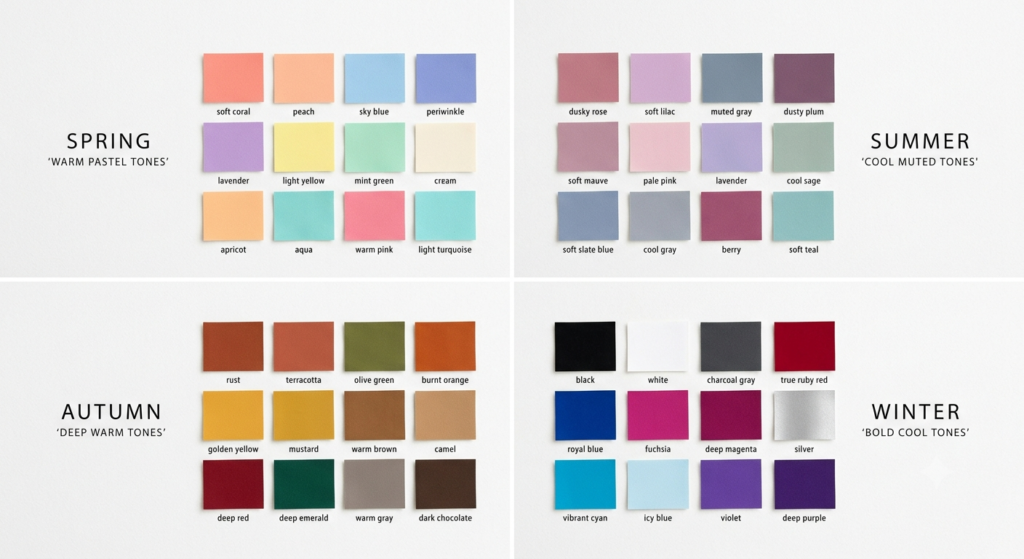
Spring Warm (봄웜톤) — Bright and warm. Peach, coral, ivory, and light gold tend to work well. Skin looks radiant and fresh. In Europe, these are the kinds of colors I associated with spring fashion — light, airy, optimistic. In Korea, if you’re a Spring, this isn’t just a seasonal aesthetic. It’s your year-round palette.
Summer Cool (여름쿨톤) — Cool and soft. Lavender, rose pink, blue-grey, and dusty white are flattering. The effect is understated and elegant. I noticed a lot of the muted tones I saw in Amsterdam streetwear — the kind of palette that looks effortlessly put-together — tend to suit Summer cool types particularly well.
Autumn Warm (가을웜톤) — Deep and warm. Terracotta, camel, olive, and earthy browns shine here. It’s grounded and rich. These are the colors I saw everywhere in Rome — ochre walls, warm leather, amber light. On the right person, they’re striking. On the wrong one, they can look heavy.
Winter Cool (겨울쿨톤) — Bold and cool. Black, wine, icy pink, and vivid red create strong contrast that lifts the face. In Germany, minimalist black-and-white dressing was practically a uniform. Now I understand why it worked so naturally — a lot of Northern Europeans tend toward cool, high-contrast coloring.
Once you know your season, the guesswork largely disappears. Lip colors, clothing shades, hair colors, even whether gold or silver jewelry works better — it all connects back to the same underlying logic.
What I Noticed as Someone Who Studied Color Theory
I graduated from the fine arts program at Hongik University, where I spent years studying color theory — color wheels, complementary relationships, color temperature, how colors interact when placed next to each other.
When I finally sat down to understand personal color analysis properly, something clicked immediately.
The entire system is built on color temperature — one of the most fundamental concepts in color theory. Warm colors carry a different visual weight than cool ones. When you place warm tones next to cool ones, they either lift each other or fight each other depending on the combination. Put an warm orange next to a cool blue and they vibrate. Put two warm tones together and they settle.
The same principle applies to skin. Warm-toned skin — with yellow, peachy, or golden undertones — responds differently to color than cool-toned skin, which carries pink, blue, or neutral undertones. When the color you’re wearing is harmonious with your natural undertone, your face brightens. When it clashes, you look tired or washed out — even if the color itself is beautiful on its own.
Color theory has understood this for centuries. What Korea did was make it radically accessible. Instead of requiring people to understand undertone theory or the mechanics of simultaneous contrast, the system collapses into four seasons anyone can remember and apply at a makeup counter.
That simplification is genuinely clever. I studied color formally for years and the framework still gave me a cleaner shorthand for what I already knew. For someone without that background, it’s even more useful — it gives you a clear answer to a question most people spend years guessing at.
In Europe, I never once heard a friend say “I can’t wear that shade because it clashes with my undertone.” People just wore what they liked and accepted the occasional mismatch as part of fashion. Korea turned that guesswork into a system.
Why Korea Became So Obsessed With This
The trend exploded between 2018 and 2020, largely driven by K-pop and celebrity culture. When Jisoo from Blackpink shared her personal color analysis on YouTube, the video pulled 2.6 million views. The topic now has over 375 million views on TikTok. Even a prominent South Korean politician made headlines when he got his colors analyzed.
But virality alone doesn’t explain why it stuck.
Korean beauty culture has always been oriented toward personalization — finding the right product for your specific skin type, rather than buying whatever’s trending. Personal color analysis extends that logic to aesthetics. Instead of wearing what’s fashionable, you wear what actually works for your face.
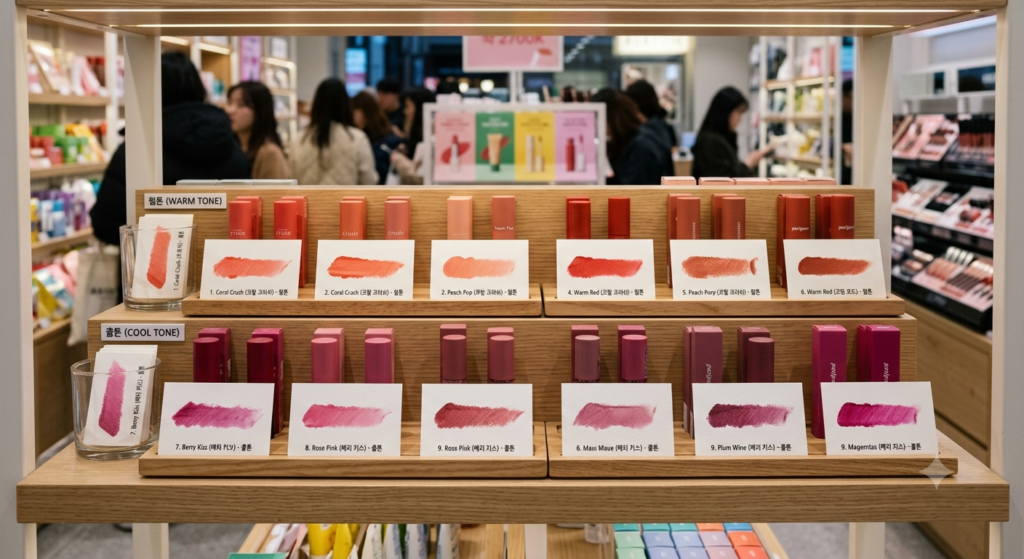
Walk into any Olive Young now and you’ll see products tagged “warm tone recommended” or “cool tone recommended.” Personal color has become a shopping filter as much as a beauty concept. If you don’t know your season, navigating a Korean makeup aisle starts to feel like reading without knowing the alphabet.
In Europe, beauty shopping worked differently. You picked a foundation that matched your skin color roughly, chose a lipstick because the display looked nice, and hoped for the best. There was no underlying system connecting all your choices. Korea built one — and once you’ve used it, going back to guessing feels unnecessarily inefficient.
“If you don’t know what your personal color is,” one Seoul-based color analyst told Time magazine, “it’s hard to shop for the appropriate makeup and clothing — and to also converse with the younger generation.” That’s not an exaggeration. It’s become that embedded in daily life here.
What Actually Happens During a Session
Sessions take place at dedicated studios, most concentrated in Seongsu-dong, Hongdae, and Gangnam.
Step 1 — Warm or Cool First
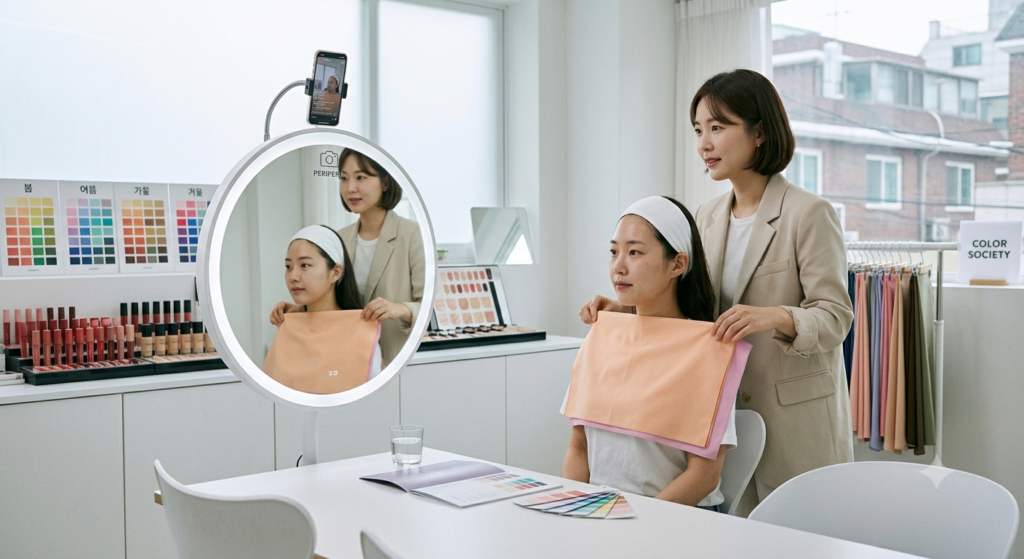
Before anything else, the consultant establishes whether you’re warm or cool. Gold and silver fabric swatches are held near your face under neutral lighting. One will make your skin look brighter. The other will make you look slightly flat. It’s often more obvious than you’d expect — and more telling than any online quiz.
Step 2 — Draping
This is the core of the session. Colored fabric swatches — called drapes — are held against your neck and chest while you look straight ahead under neutral light. Each color either enhances or diminishes your features in real time. Under-eye circles become more or less visible. Skin looks more or less even. The difference between a flattering color and an unflattering one shows up within seconds.
From a color theory standpoint, what you’re watching is simultaneous contrast — the way adjacent colors influence how we perceive each other. Seeing it applied to a person’s face rather than a canvas is genuinely fascinating.
Step 3 — Your Season Is Confirmed
Within your warm or cool category, the consultant narrows to your specific season. Some studios go further, identifying sub-seasons for more precise recommendations.
Step 4 — You Leave With a Color Palette
Most studios provide a PDF with your best colors across clothing, lip shades, blush tones, hair color suggestions, and jewelry metal preferences. It becomes a reference you actually use while shopping — and the difference it makes is real.
Can Foreigners Get This Done in Seoul?
Yes, and increasingly easily. The surge in international interest has pushed many studios to offer English sessions as a standard option, particularly in tourist-heavy areas.
How to Book
Search Instagram for “personal color analysis English Seoul” or “퍼스널 컬러 English.” Most studios book via Instagram DM or KakaoTalk. Book at least two to four weeks in advance — walk-in availability at reputable studios is essentially nonexistent.
What It Costs
Expect to pay between 50,000 and 150,000 KRW depending on the depth of analysis. For context, a comparable session in the US typically costs $500 or more. Getting it done in Seoul is one of the most underrated value propositions in Korean beauty tourism.
Where to Go
Studios in Hongdae and Seongsu-dong tend to be most experienced with international clients. Confirm English availability before booking — a quick DM on Instagram is the fastest way to check.
How It Changed the Way I Shop
In Europe, I bought colors I liked. That sounds fine, until you realize how many lipsticks I owned that I never actually wore. The gap between “I like this color” and “this color works on me” turned out to be larger than I’d realized.
After getting my personal color analyzed, that gap closed. The biggest shift was with lip colors — I stopped reaching for shades that looked beautiful on their own and started choosing ones that made my face look more alive. The difference wasn’t subtle. My friends noticed before I told them what had changed.
Personal color analysis isn’t a rulebook. Wearing a color outside your season isn’t wrong. If you love a shade, wear it. But if you’ve ever bought something that looked perfect in the store and fell flat at home, knowing your season removes most of those mistakes. And after years of shopping across Europe without that framework, having one makes the process feel noticeably cleaner.
FAQ About Personal Color Analysis in Korea
Does personal color analysis work for all ethnicities?
Yes. The system is based on undertones and natural coloring, not on race. Many studios in Seoul now regularly work with international clients of all backgrounds, and English-language sessions are widely available.
Can my personal color change over time?
Your warm or cool classification stays consistent because it’s based on underlying skin pigment. However, major changes to hair color or significant tanning can temporarily affect which sub-season fits best.
Is the result definitive?
No — and good consultants will say so. Personal color is a framework, not a strict set of rules. Use it as a shortcut for better decisions, not as a reason to avoid colors you genuinely love.
Are English-language sessions easy to find?
Increasingly yes. International demand has pushed many studios to add English as a default option. Checking Instagram before booking is the most reliable way to confirm.
How long does a session take?
Most sessions run one to one and a half hours. More detailed analyses, including sub-season identification, can take closer to two hours.
How much does it cost compared to other countries?
In Seoul, expect roughly $40 to $120 USD. In the US, comparable services typically run $500 or more. The value difference is significant.
Have you had your personal color analyzed — in Korea or anywhere else? And if you’ve been going back and forth on booking a session in Seoul, I’d love to hear what’s holding you back. Drop it in the comments.
🔗 Internal Link Suggestions